Any one of those would slide by. Together, they plant a small doubt right as that person decides whether to reach out.
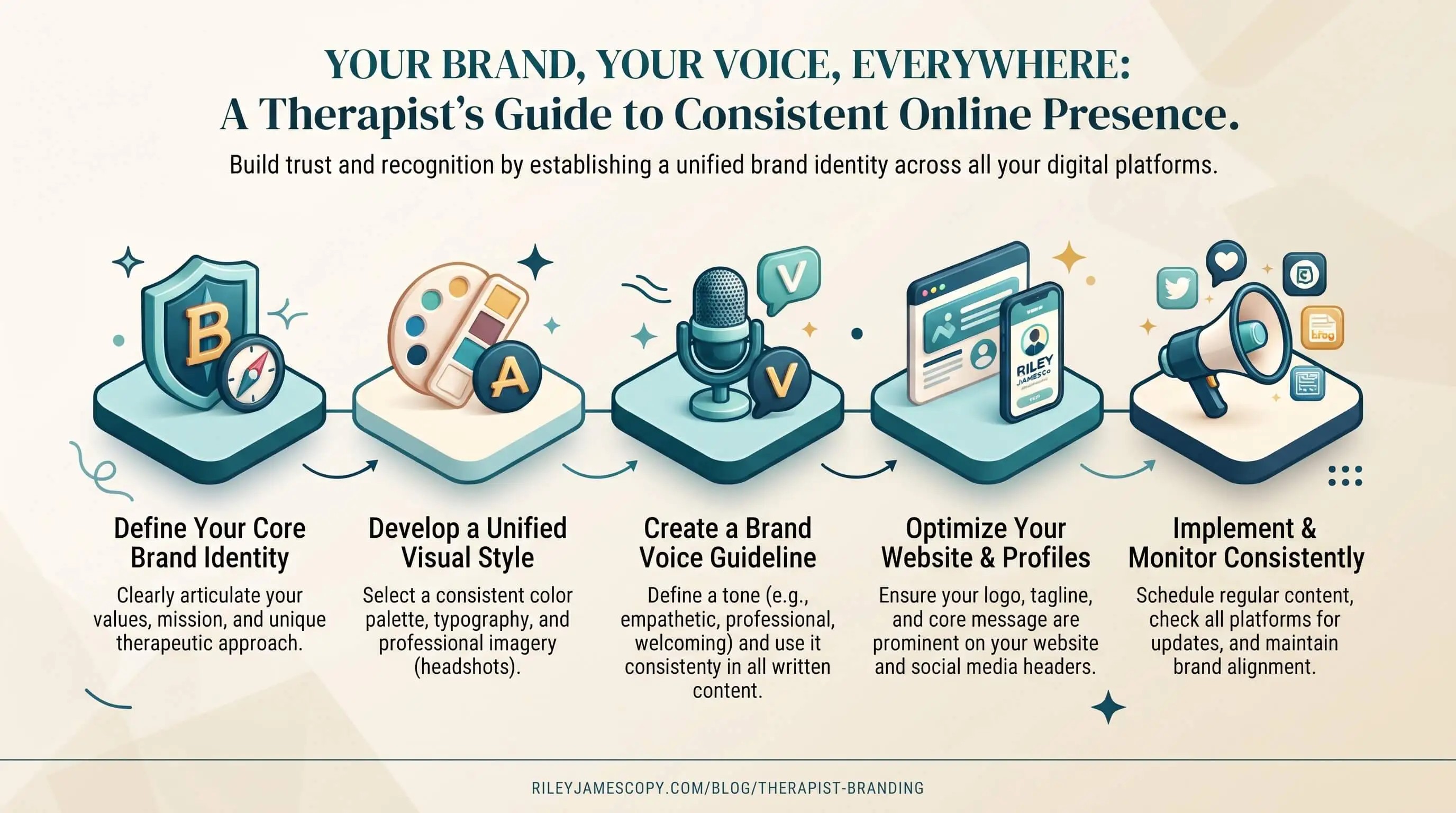
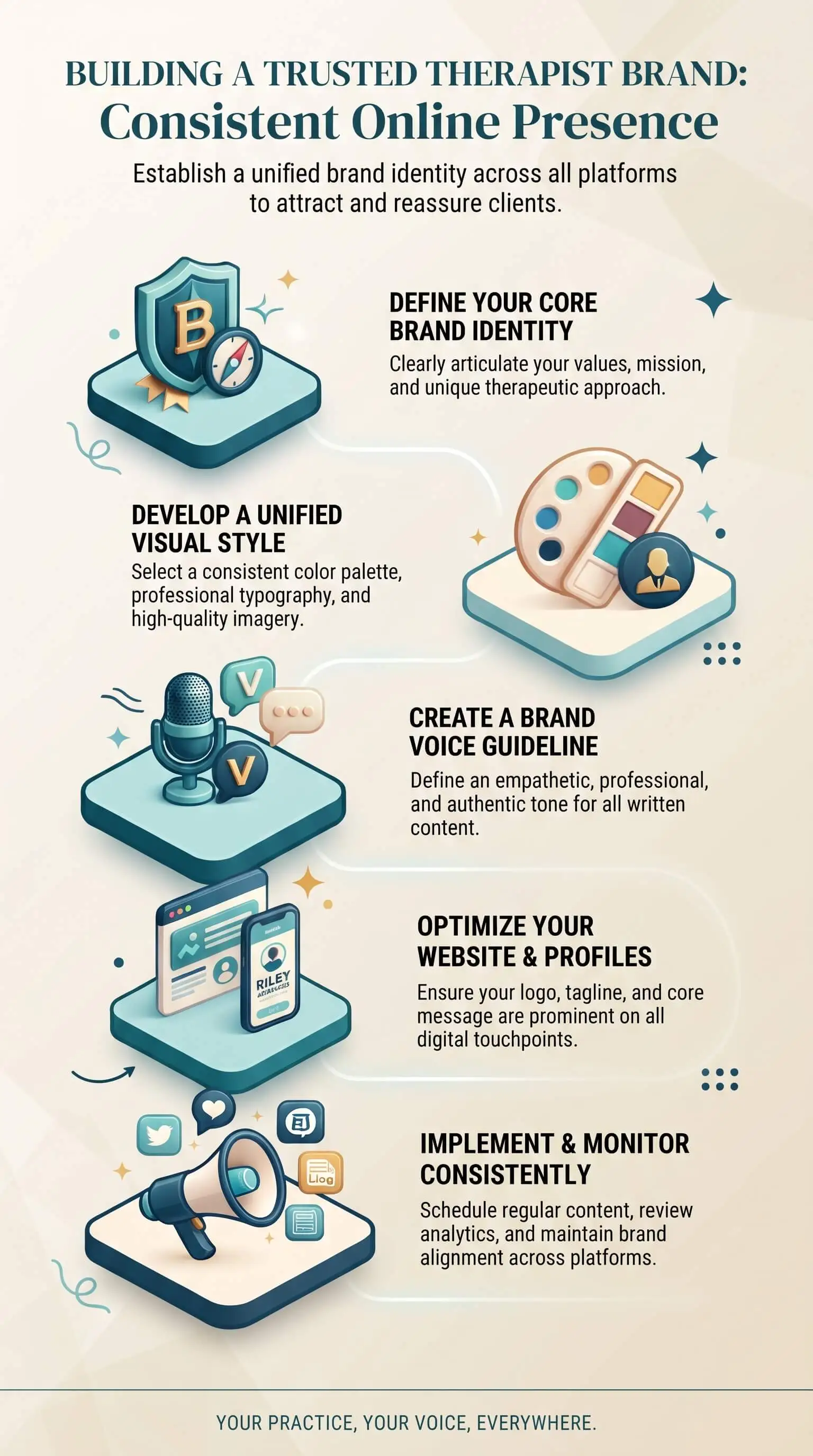
In brand marketing for therapists, consistency means your name, credentials, specialty, voice, and look match everywhere a client can find you, so each page they open backs up the one before. Whether you practice therapy solo or run a small group, most of the fix is housekeeping. You already know how to keep a tidy office, and this is the online version of that.
TL;DR Quick Answers
Brand Marketing For Therapists
Brand marketing for therapists is how a private practice shows the right clients who it helps, how it works, and what working together feels like, then carries that same message everywhere those clients look. It works best when the brand holds steady from your website to your directory profiles to your welcome email.
What it takes:
A clear specialty that names a person and a moment, which a diagnosis alone can't do.
Plain, warm words in your client's language in place of clinical jargon.
Matching details everywhere, from your name and credentials to your photo, fees, and booking link.
Ethical guardrails, with no promised outcomes and no solicited testimonials.
A quarterly check so the message stays put.
Get those right, and the right client recognizes you before the first session.
Top 5 Takeaways
Clients read consistency as reliability, and reliability is exactly what an anxious client is screening for.
Match your name, credentials, and contact details exactly, because Google and AI tools compare them across listings.
Repeat one specialty sentence everywhere. It does more work than five different bios ever will.
Every platform has its own format, and your message should come through each one unchanged.
A one-page style guide plus a 30-minute quarterly audit keeps the brand from drifting.
Why Does Brand Consistency Matter So Much For Therapists?
For a therapy client, consistency works as a safety signal long before it works as marketing. People who reach out for help are often anxious or worn down. They're scanning for clues about whether you're dependable, and a practice that looks and sounds the same everywhere answers that quietly.
Search engines care about it too. Google asks businesses to represent themselves the way they're known in the real world, across signage, stationery, and other branding. Its systems, along with the AI assistants built on search, compare your name, address, phone number, and specialty across listings. This applies to healthcare practices and other organizations, including a private school. Conflicting details give them less reason to trust any one version of you.
In my work with private practices, the most common gap is a polished website sitting next to a directory profile nobody has opened in three years.
What Should Stay The Same On Every Platform?
Some details should never move from one platform to the next. Others can bend to fit the format, and that's fine.
Must stay the same:
Practice name, your name, and the way you write your credentials
Address, phone number, email, and booking link
Your one-sentence specialty statement
Your current headshot
Core colors, logo, and fonts
Fees, insurance, and availability details
Can flex by platform:
How long your bio or description runs
Post format and how often you post
Image crops and sizes
How much personality the tone carries
The wording of your call to action
Your Core Identity Details
Pick one way to write your name and credentials, then use it everywhere. If your website says "Jane Doe, LMFT," one directory shouldn't spell out "Licensed Marriage and Family Therapist" while another shortens you to "J. Doe." Keep one address format, one phone number, one email, and one booking link.
Your Specialty Statement
Write a single sentence that names who you help and what you help with, and make it the opening line of every profile. Here's an illustrative example: "I help adult children of immigrants who feel pulled between two cultures." Picking the niche takes its own thinking, so this step only makes sure it travels with you.
Your Voice And Tone
An Instagram bio gives you 150 characters, and an About page might run 600 words. Both should sound like the same calm, plain-spoken person. When your website says "you don't have to have it all figured out" and LinkedIn says "evidence-based modalities for optimal outcomes," readers feel the switch even if they couldn't tell you what changed.
Your Visual Identity
Use one current headshot, two or three brand colors, one logo file, and one font pairing. When the headshot changes, change it everywhere on the same afternoon.
How Do You Build A Simple Brand Style Guide For Your Practice?
A one-page style guide is the cheapest consistency tool a solo practice has. It can be a single page that you (or an assistant, or a clinician who joins later) copy from, which beats typing from memory every time.
Identity block. Practice name, your name and credentials exactly as written, address, phone, email, and booking link.
Specialty sentence. The one line, plus a 50-word and a 150-word version for profiles with more room.
Voice notes. A few words that describe how you sound, with some "we say / we don't say" pairs.
Visual files. Color codes, logo files, font names, and the approved headshot.
Profile list. Every platform you're on, who holds the login, and when it was last updated.
Compliance notes. What your ethics code says about claims, testimonials, and reviews, so nobody has to look it up twice.
For a fuller version of the same idea, this guide to the brand bible secrets every business needs is worth a read.
Platform By Platform: How Do You Adapt Without Drifting?
Each platform hands you a different-sized box to fill, and your message should fit every one of them without changing shape.
Your Website
Your website is home base, and every other profile points back to it. If the message there still sounds like every other practice in town, fix that before you match anything. This guide to brand marketing for therapists walks through positioning, messaging, voice, and ethics, which is the groundwork that makes consistency worth the effort.
There's one behind-the-scenes step I'd add. Ask whoever manages your site to add Organization structured data with a sameAs list pointing to your directory and social profiles. Google describes sameAs as a link to your organization's profile on another site, and it helps its systems understand that all those pages belong to one practice.
Psychology Today And Other Directories
Directories line you up in a grid beside dozens of other clinicians, so your profile has to look like you at a glance. Paste your specialty sentence in as the opening line. Then match the headshot, fees, insurance, availability, and booking link to your website. When your website changes, update Psychology Today, TherapyDen, and any insurance network listings that same week.
Google Business Profile
Use your practice name exactly as it appears on your website and signage. Google's guidelines don't allow extra keywords or descriptors in the business name, and they recommend choosing the fewest categories that describe your core service. Individual practitioners can include a title or degree, so write it the same way you do everywhere else. Reuse your website description, and if you only see clients by appointment, Google's guidelines suggest leaving hours off entirely.
Social Media
Use the same profile photo and the same bio line on Instagram, LinkedIn, and Facebook. Two platforms you keep current will do more for you than five that went quiet last spring. If you're building a personal presence alongside the practice, these steps for branding yourself online as a creative professional translate well to clinicians.
Email, Intake Forms, And Telehealth
These touchpoints get forgotten because they show up after the click. Check your email signature, your auto-reply, your welcome email, the intake paperwork, and the telehealth waiting room. A warm website followed by a stiff form-letter welcome email gives back some of the trust you just earned, so carry the same name, logo, and tone through all of them.
How Do You Keep Your Brand Consistent And Ethical?
Consistency includes your credentials, and that's where it turns into an ethics question. The APA Ethics Code counts directory listings as public statements, and it bars psychologists from making false or deceptive statements about their credentials, degrees, services, or fees. A credential written one way on your website and another way on a directory can start to look like misrepresentation, even when it's only an old typo. The same principle of accurate, consistent messaging applies to a board game crowdfunding strategy, where clear claims help build trust with potential backers.
A few guardrails I'd write straight into your style guide:
Credentials and fees match everywhere, down to the abbreviation.
Results claims stay out of every bio and post. Promising outcomes is a quick way to cross the line on any platform.
Reviews and testimonials follow your profession's code. The APA code bars soliciting testimonials from current clients, and counselors, social workers, and MFTs each have their own rules.
Privacy reaches into the tools on your website. Tracking pixels on booking or contact pages deserve a second look against HHS guidance.
I write the copy and flag anything that looks risky. You and your licensing board make the final call, because I'm a copywriter and not a compliance attorney.
How Do You Audit Your Brand Across Platforms?
Block 30 minutes on your calendar once a quarter. Most brands drift one quick edit at a time, which is why branding longevity depends on upkeep as much as on design.
List every place your practice shows up online.
Open them all in side-by-side tabs.
Check your name, credentials, address, and phone character by character.
Compare the specialty sentence on each one.
Swap out any old photo.
Click every booking link and call every listed number.
Search your name and practice name on Google, then ask an AI assistant what it knows about your practice.
Fix what you found and update the dates in your style guide.
"Years of pastoral work taught me that people decide to trust you across a dozen small moments, and most of those happen before you ever say a word. When I audit a therapist's online presence, I'm looking for the spots where the story changes, because something outright broken is rare. If a client sees the same face and the same warmth on three different platforms, they've already had a small experience of you showing up the same way every time. That happens to be the first thing therapy asks of them, too."
Essential Resources
These are the seven pages I'd bookmark before touching a single profile. Every one is a primary source, and I've ordered them from the platforms themselves to the rules that govern what you say on them.
Set Up Your Google Business Profile The Right Way
Google's own rules for business names, addresses, categories, and individual practitioners live here. Read the name section first, since stuffing keywords into your business name can get a profile suspended.
Source: Google Business Profile Help: Guidelines for Representing Your Business on Google
Connect Your Website To Your Profiles
Google's Organization structured data page explains sameAs, along with the other details that help search engines tell your practice apart from one with a similar name.
Source: Google Search Central: Organization Structured Data
See How Google's AI Features Find Practices
Google's guide to its generative AI features keeps coming back to the basics. Original, people-first content and accurate business details through tools like Business Profile still do the heavy lifting.
Source: Google Search Central: Optimizing for Generative AI Features on Google Search
Borrow An Accessibility Rule For Your Brand
The W3C's consistent identification guideline explains why people rely on familiar labels and cues to recognize the same thing in a new place. It was written for buttons and menus, and it applies just as well to a practice name and a headshot.
Source: W3C WAI: Understanding Success Criterion 3.2.4, Consistent Identification
Check Every Claim Against The APA Ethics Code
Standard 5 covers advertising and public statements, directory listings and testimonials included. If you're a psychologist, read it before you publish a profile. If you hold another license, read your own code alongside it.
Source: American Psychological Association: Ethical Principles of Psychologists and Code of Conduct
Keep Reviews And Endorsements Honest
The FTC's plain-language Q&A covers endorsements, online reviews, and disclosure. Pull it up any time a platform nudges you to collect reviews or a colleague offers to post about you.
Source: Federal Trade Commission: FTC's Endorsement Guides, What People Are Asking
Review The Tools Running On Your Website
HHS explains how HIPAA applies when covered entities use tracking technologies on websites and apps. A federal court vacated part of this bulletin in 2024, so read the note at the top and check with your compliance advisor.
Supporting Statistics
I watch these numbers whenever I help a practice clean up how it shows up online.
1. Clients Meet Your Practice Online Before They Ever Call
In the second half of 2022, 58.5% of U.S. adults used the internet to look for health or medical information, and 41.5% used it to communicate with a doctor or doctor's office.
For a lot of your future clients, the online version of you comes first, and it keeps showing up after they book. Each of those touchpoints should sound like the same practice.
2. Clients Are Shopping Through Full Calendars
In APA's 2024 Practitioner Pulse Survey, 53% of psychologists said they had no openings for new patients.
With that many doors closed, people click through profiles fast. A fee, availability note, or booking link that doesn't match your website can lose someone at the exact spot where you could actually help.
Source: American Psychological Association: 2024 Practitioner Pulse Survey
3. Too Many People Still Go Without Care
Among the 14.6 million U.S. adults with serious mental illness in 2024, 70.8% received any mental health treatment, so nearly 3 in 10 did not.
Plenty keeps people from care, and consistent information won't fix most of it. It does remove one more reason to give up halfway through looking.
Source: SAMHSA: 2024 National Survey on Drug Use and Health Release
With many clients searching for healthcare online, limited therapy openings, and ongoing gaps in mental health treatment, consistent information across websites and directory profiles matters. These medical copywriting tips emphasize clear fees, accurate availability, and accessible booking details to build trust, reduce confusion, and help clients take the next step toward care.
Final Thoughts And Opinion
After years of writing for healthcare practices, I'm convinced a scattered therapist brand almost always comes down to maintenance. The website got a refresh two years ago, the directory profile didn't, and now the practice tells several slightly different stories.
The fix is small and a little boring (which, honestly, is good news):
One identity block you copy from every time.
One specialty sentence that opens every profile.
One photo, updated everywhere on the same day.
One quarterly audit that catches drift before clients notice it.
Matching an unclear message across six platforms only spreads the confusion further, so brand marketing for therapists starts with knowing who you help and saying it plainly. Consistency is what carries that message to every place a nervous person might find you.
And if all you need right now is to clean up one stale directory profile, start there. You can be consistent without a rebrand.
Frequently Asked Questions
Q: What Does Brand Consistency Mean For A Therapist?
A: A client sees the same name, credentials, specialty, photo, and tone wherever they find you, from your website to Psychology Today to your welcome email. Each touchpoint backs up the last one, so trust builds instead of starting over.
Q: Which Online Platforms Matter Most For A Therapy Practice?
A: Start with your website, your Google Business Profile, and the one or two directories your clients actually use. Social media is optional. Get those core pieces consistent before you add anything new.
Q: Do I Need The Same Photo On Every Platform?
A: Yes. A matching headshot is the quickest way for someone to recognize they've found the same person, so update it everywhere on the same day.
Q: How Often Should I Update My Directory Profiles?
A: Any time your website changes, plus once a quarter during your audit. Fees, insurance, and availability go stale fastest.
Q: Does Inconsistent Information Hurt My Google Visibility?
A: It can. Google asks businesses to represent themselves the way they're known in the real world, and conflicting details leave its systems less sure which version is right.
Q: Can My Tone On Social Media Differ From My Website?
A: A little. Social posts can run more casually, as long as the person behind them sounds familiar: warm and careful with claims.
Q: What Belongs In A Therapist Brand Style Guide?
A: Your identity block, specialty sentence, voice notes, visual files, a list of every profile, and short compliance notes from your ethics code. One page covers it.
Q: How Is Brand Marketing For Therapists Different From Branding Any Small Business?
A: Your readers are often vulnerable, so the brand has to signal safety first. Your ethics code also limits claims and testimonials in ways most small businesses never deal with.
Ready To Make Your Brand Match Everywhere?
You don't have to overhaul anything tonight. Open your website and your main directory profile side by side, find the first detail that doesn't match, and fix it. Then do the next one.
If you'd rather hand it off, Riley James Copy helps solo and small practices with private practice healthcare copywriting to create one clear message and carry it to every profile, so the right client recognizes you on the first read. Grab a free 15-minute call, and we'll work out which profile to fix first.


