A multicultural marketing agency is a marketing agency whose team is built from the communities it serves — not one that researches those communities from the outside.
That one distinction is what brands almost always underestimate when they first ask this question.
After years of building multicultural campaigns from the inside — and watching general market agencies attempt the same work from the outside — the gap between those two approaches is not subtle. It shows up in the language that lands and the language that misses. In the cultural references that build trust and the ones that quietly signal a brand does not really know who it is talking to. In the community relationships that exist before a campaign launches and the ones that have to be purchased, one impression at a time, after the fact.
A multicultural agency does not close that gap by hiring diverse talent as a review layer at the end of a process built by people who do not share the community's lived experience. It closes that gap by building the entire process — strategy, creative, execution — from teams whose cultural fluency is not a credential. It is a biography.
What this page covers:
What a multicultural marketing agency actually is — and what it is not
Why the source of cultural insight determines campaign outcomes more than budget or creative quality
What minority ownership signals about an agency's structural commitment to the communities it serves
How to evaluate whether an agency's multicultural expertise is genuinely embedded or surface-level
How small businesses can find culturally embedded agencies on real budgets — using the right shortlisting process
If you are asking this question because you are deciding whether a multicultural agency is right for your brand — the answer is almost certainly yes. The more useful question is which one. And how to tell the difference between agencies that are built for this work and agencies that are positioned for it.
That is exactly what this page is here to help you answer about top multicultural marketing agencies.
TL;DR Quick Answers
Top Multicultural Marketing Agencies
What they are: Agencies built from the communities they serve — not agencies that study those communities from the outside. The defining variable is not the service list. It is the source of the cultural intelligence driving the work.
What separates the best from the rest:
Team composition that reflects the community being reached — not just leadership bios
Minority ownership that embeds cultural accountability at every stage of the work
Lived cultural experience that produces resonance no research brief can replicate
Verified outcomes from campaigns — not just awards or portfolio samples
Community relationships built over years — not assembled for a pitch
The data every brand should know before evaluating any agency:
84% of marketers believe they do multicultural marketing — only 16% embed actual cultural relevance in their creative (ANA AIMM)
Cultural relevance explains 66% of ads' sales lift and 89% of brand trust lift (ANA AIMM CIIM)
Minority populations projected to reach 57% of U.S. population by 2060 (U.S. Census Bureau)
Youth under 18 are already majority-minority — the primary consumer base of the next decade is multicultural today
The question that cuts through every agency pitch: Does the cultural intelligence driving this work come from teams who belong to the community — or teams assigned to research it? The community will know the difference. The data confirms they act on it.
Where to find verified multicultural agency lists:
Agency Spotter: https://www.agencyspotter.com/search?industry_ids[]=46
Sortlist U.S.: https://www.sortlist.com/s/multicultural-advertising/united-states-us
VAB Directory: https://thevab.com/multicultural-focused-agencies
ANA AIMM Benchmarks: https://www.ana.net/micpackage/show/id/87207
Top Takeaways
The definition most brands find is accurate but incomplete. A multicultural agency is not defined by its service list. It is defined by the source of its cultural intelligence. The variable that matters: whether that intelligence is owned or outsourced, lived or learned, built into the foundation or added as a capability layer after the fact.
84% of marketers believe they do multicultural marketing. Only 16% actually embed cultural relevance in their creativity. The 68-point gap is not a budget gap or an effort gap. It is a proximity gap. Closing it requires a different kind of agency — not a larger spend.
Minority ownership is the most reliable structural signal of cultural proximity. It determines:
Who is in the room when strategy is built
Who reviews creative before it reaches the community
Whether cultural accountability runs through the foundation or sits on top of it
The demographic shift is not a future market to prepare for — it is the current market to operate in. Three data points make this clear:
Minority populations projected to reach 57% of U.S. population by 2060
Youth under 18 are already majority-minority
Brands building multicultural agency relationships now are not ahead of the curve — they are ahead of the market
The right question is not what is a multicultural marketing agency — it is what kind. Before evaluating any agency, ask:
Is the cultural intelligence owned or outsourced?
Is it lived or learned?
Is it embedded in the team's biography or added as a review layer at the end?
The communities being reached will know the difference. The data confirms they act on it.
The Definition Most Brands Get Wrong
Most brands define a multicultural marketing agency by its services. Strategy. Creative. Media planning. Community outreach. The problem with that definition is that every general market agency offers the same list.
The accurate definition is not about what a multicultural agency does. It is about where it comes from.
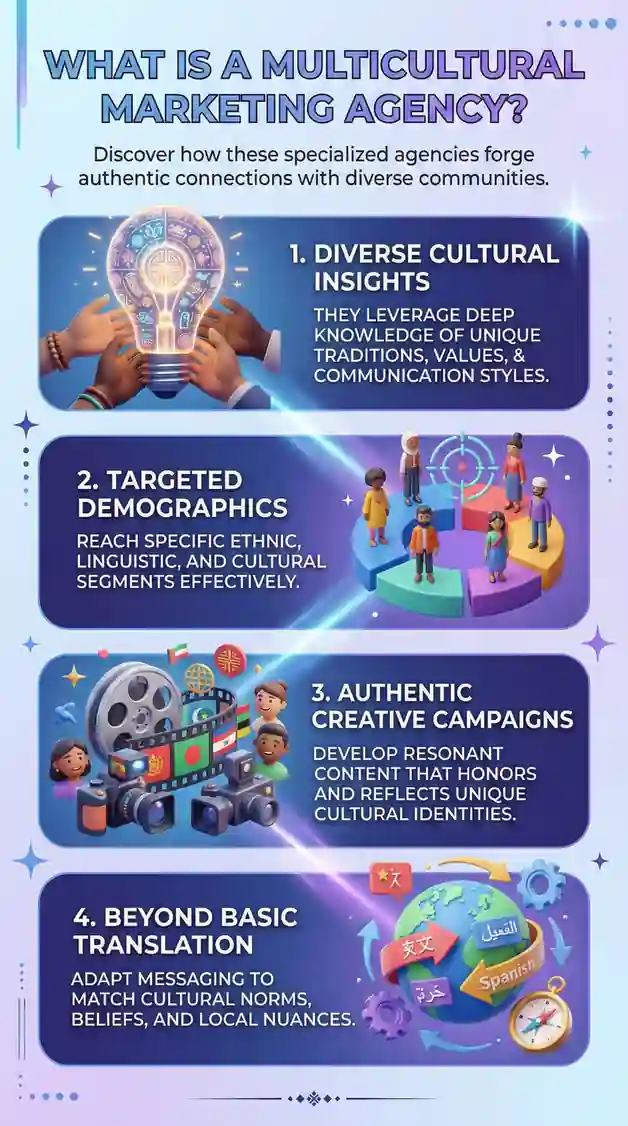
A multicultural marketing agency is an agency whose cultural intelligence is structural — built into the team, the ownership, the relationships, and the process — rather than added as a capability layer on top of a general market foundation.
That difference is invisible in a pitch deck. It is unavoidable in the work.
What A Multicultural Agency Actually Does Differently
The services may look identical on paper. What differs is the source of every decision made within those services.
Strategy: A multicultural agency builds audience strategy from lived cultural knowledge — understanding not just demographics but values, behaviors, community dynamics, and the specific cultural moments that create genuine brand relevance. A general market agency builds audience strategy from research. Both approaches produce a strategy document. Only one produces insight that a community recognizes as real.
Creative: Multicultural creative is not translated to general market creative. It is work conceived from inside a cultural context — where language, imagery, humor, reference points, and emotional triggers are understood from experience rather than derived from a brief. The difference between the two is immediately legible to the audience being reached.
Community relationships: The most underleveraged asset a multicultural agency brings is not on any capability slide. It is the existing relationships with community organizations, influencers, media, and gatekeepers that took years to build. Those relationships cannot be purchased. They can only be inherited — from an agency whose team already belongs to the community.
The Difference Between Cultural Proximity And Cultural Familiarity
This is the distinction that matters most — and the one most brands do not know to look for until after a campaign has already missed.
Cultural familiarity is knowing about a community. It is research, data, trend reports, and demographic analysis. It produces technically accurate work that communities often experience as flat, generic, or subtly off in ways that are difficult to articulate but impossible to ignore.
Cultural proximity is belonging to a community. It is lived experience, personal relationships, genuine cultural fluency, and the instinctive understanding of what resonates and what alienates. It produces work that communities recognize as being made for them — not at them.
After years of seeing both in practice, the gap between familiar and proximate shows up in three specific places:
The cultural references that feel current versus the ones that feel researched
The language that sounds like the community versus the language that sounds like a brief about the community
The instinctive recognition of what not to say — which no amount of research fully replicates
Why Minority Ownership Is A Structural Signal — Not A Marketing Claim
Minority ownership matters in multicultural marketing for one reason above all others: it determines who holds accountability for the work at every stage.
When an agency is minority-owned, the people responsible for strategy, creative direction, and client relationships are the same people who share cultural stakes in getting it right. That is not a diversity metric. It is an operational reality that shapes every decision in the process — from who is in the room when strategy is built to who reviews creative before it reaches the community.
The U.S. Census Bureau reports that 22.6% of all U.S. employer businesses are minority-owned. The brands that choose to partner with agencies from that pool are not making a symbolic choice. They are choosing a structural advantage — an agency whose accountability to the community being reached is built into its ownership, not added to its pitch.
What This Means For Small Businesses With Real Budget Constraints
The most important thing to understand about multicultural agency selection on a limited budget is this: cultural proximity does not scale with agency size.
Some of the most culturally embedded, outcomes-driven multicultural agencies in the country are boutique firms. Lean teams. Minority-owned. Built on deep community relationships rather than large overhead structures. Their work outperforms larger generalist agencies on cultural resonance not because they spend more — but because they come from the communities they serve.
For small businesses, this changes the budget conversation entirely:
The goal is not to find the most affordable agency on a broad list
The goal is to find the most culturally proximate agency within a realistic budget range
Those agencies exist at every price point
Finding them requires the right shortlisting process — not a larger budget
The Question Every Brand Should Ask Before Signing Any Agency
Not: what is your multicultural marketing experience?
That question produces a list of credentials.
The question that produces useful information is: who is actually on the team that will work on this account — and what is their relationship to the community we are trying to reach?
That question cuts through positioning, portfolio presentation, and pitch performance. It gets directly to the variable that determines whether the work will resonate or miss — and whether the investment, at any budget level, will convert or disappear.
After years of building multicultural strategy from the inside, that is the question we come back to every time. It is the one that separates the agencies that are built for this work from the agencies that are positioned for it.
"The question we hear most often from brands evaluating multicultural agencies is: how do we know if an agency really understands our audience? After years of doing this work, our answer is always the same — stop asking about understanding and start asking about origin. Understanding can be researched. Origin cannot. The agencies that produce work communities actually recognize them as their own are not the ones that studied those communities the hardest. They are the ones whose teams grew up inside them, built relationships inside them, and carry an instinctive cultural fluency that no brief, no focus group, and no diversity audit can replicate. That is the variable most brands are not evaluating — and it is the only one that consistently determines whether a multicultural campaign builds community trust or quietly spends it down."
Essential Resources
Understand the Industry Standard for What Multicultural Marketing Actually Means
Before you can evaluate any agency's claim to do multicultural marketing well, you need to know what the industry's highest standard actually looks like. The ANA DEIB Resource Center is the most authoritative starting point — covering definitions, frameworks, and structural requirements that separate genuine multicultural marketing from general market work with a diverse cast. Use it before your first agency conversation, not after. ???? https://www.ana.net/deib
Measure Whether an Agency's Cultural Intelligence Meets the Bar That Moves Revenue
Most agencies claim cultural intelligence. Few can demonstrate it against an objective standard. ANA AIMM — the Alliance for Inclusive and Multicultural Marketing — provides the industry's most credible cultural inclusion benchmarks, including the CIIM research confirming that culture explains 66% of ad sales lift and 89% of brand trust lift. This is the standard every multicultural agency should be held to — and the resource that tells you what meeting that standard actually requires. ???? https://www.ana.net/micpackage/show/id/87207
Know What You Should Be Buying Before You Decide Who to Buy It From
The most common mistake brands make when evaluating multicultural agencies is not knowing what genuine multicultural strategy looks like before they start comparing proposals. The ANA School of Marketing's multicultural strategy course covers the core distinctions between multicultural and general market approaches — including the cross-cultural insight development, audience-based communications, and common fallacies that cause most multicultural campaigns to miss. Use it to build the evaluation criteria the right agency should be able to meet. ???? https://www.ana.net/ondemand/show/id/OD-IMCS
Understand the Market Your Agency Claims to Know Before You Trust Them to Navigate It
The best multicultural agencies do not just know minority-owned business data. They operate inside it. The U.S. Census Bureau's 2023 Annual Business Survey gives you the most current federal picture — 1.3 million minority-owned employer firms representing 22.6% of all U.S. employer businesses, with hundreds of billions in receipts across Asian, Hispanic, and Black-owned firms. Understanding this landscape before your agency conversations means you can tell the difference between an agency that knows these numbers and one that lives inside them. ???? https://www.census.gov/newsroom/press-releases/2024/employer-businesses.html
Know the Federal Agency Built for the Communities Your Multicultural Agency Should Already Have Relationships With
The agencies that perform best in multicultural markets are not discovering these communities when a client brief arrives. They already have roots in them. The Minority Business Development Agency (MBDA) — the only federal agency created specifically to foster minority-owned business growth in America — provides the research, resources, and community context that define the landscape the best multicultural agencies are built from. If your agency cannot speak to this ecosystem, that is a signal worth paying attention to. ???? https://www.mbda.gov
Ground Your Agency Decision in the Buying Power Data That Defines What Is Actually at Stake
An agency evaluation made without understanding the true scale of multicultural buying power is an evaluation made without the most important context. The UGA Selig Center for Economic Growth's Multicultural Economy Report — the longest-running annual research series of its kind — tracked total U.S. buying power at $18.5 trillion in 2021, a 329% increase since 1990. This is the market your multicultural agency is being hired to help you reach. Understanding its scale changes what you are willing to invest to reach it well. ???? https://www.terry.uga.edu/americas-economy-continued-grow-and-diversify-while-recovering-covid-19/
See the Consumer Behavior Data That Defines What a Genuinely Effective Multicultural Agency Must Be Able to Deliver
Cultural resonance is not a qualitative judgment. It is a measurable driver of purchase behavior. Nielsen's 2023 Hispanic Diverse Intelligence Series confirms that 84% of Latino consumers favor brands that play a positive role in their community and 63% are more likely to purchase from brands that reflect their identity. This data sets the performance bar every multicultural agency should be accountable to — and reframes cultural proximity from a values statement into a revenue variable. ???? https://www.nielsen.com/insights/2023/nurturing-trust-engaging-with-hispanic-audiences-in-a-diverse-media-landscape/
Supporting Statistics
These are not diversity statistics. They are market statistics. The brands that understand what is happening demographically and economically — and build agency relationships to match — are the ones positioned to grow. The ones that don't are not just missing an audience. They are missing the market.
84% of marketers believe they do multicultural marketing. Only 16% actually embed cultural relevance in their creativity. The gap is not effort. It is proximity.
This is the statistic we return to more than any other when a brand asks why their multicultural campaigns are not performing.
What most brands are actually doing:
Delivering demographically targeted media placements
Around work conceived, written, and approved by people who don't share the cultural context of the audience being reached
The community feels that gap — in language that sounds researched rather than lived, in cultural references that land a beat too late, in casting that checks boxes without communicating belonging
ANA AIMM's Cultural Insights Impact Measure confirmed what we have seen in practice for years. Closing that gap is not a creative quality issue. It is a proximity issue. It is the specific gap a genuinely multicultural agency — whose team is built from the communities being reached — is structurally positioned to close.
By the numbers:
84% of marketers believe they do multicultural marketing
Only 16% infuse actual cultural relevance into brand creative
Cultural relevance explains 66% of ads' sales lift and 89% of brand trust lift
Cultural relevance drives a 3x increase in purchase intent when genuinely embedded in creative
P&G's Marc Pritchard confirmed: culturally connecting with Hispanics on a single brand means $1 billion on that brand's bottom line
What we see in our work: When clients come to us after a multicultural campaign has underperformed, creativity is rarely the problem. The process that produced it is. Cultural familiarity consistently produces work that is technically correct and experientially flat. Cultural proximity produces work communities recognize as their own. The 68-point gap between 84% and 16% is exactly the distance between those two types of agencies.
Source: ANA AIMM — Cultural Insights Impact Measure (CIIM), Alliance for Inclusive and Multicultural Marketing https://www.ana.net/micpackage/show/id/87207
The U.S. is projected to become majority-minority by 2045. Brands building authentic multicultural agency relationships now are not ahead of the curve. They are ahead of the market.
What this data means in practice, based on real client engagements:
Brands that internalized this shift early:
Already have community trust that took years to build
Have audience relationships that cannot be purchased with a single campaign budget
Are not scrambling to catch up — they built presence before it felt urgent
Brands that waited are discovering something more expensive than a missed campaign. Cultural trust does not respond to budget increases. It responds to time, consistency, and genuine community presence — the kind that only comes from partners who already belong to the communities being reached.
By the numbers:
U.S. projected to become majority-minority by 2045 — no single group will hold a demographic majority
Minority populations projected to reach 57% of total U.S. population by 2060
Total minority population projected to more than double — from 116 million to 241 million
Youth under 18 are already majority-minority — the primary consumer base of the next decade is multicultural today
Hispanic, Asian American, and multiracial populations are the only groups currently driving positive U.S. youth population growth
What we see in our work: Los Angeles — where The Sax Agency is based — is already living this demographic reality. This is not a future market to prepare for. It is the current market we operate in every day. The brands that thrive here are not the ones that respond to demographic data with a targeted campaign. They are the ones that made the decision years ago to build authentic relationships with these communities through partners who already had them.
Source: U.S. Census Bureau, National Population Projections https://www.census.gov/newsroom/releases/archives/population/cb12-243.html
Ethnic diversity in the advertising and marketing industry declined in 2023 — from 32.3% to 30.8%. The agencies that held their cultural composition during that decline are the ones whose work held its integrity.
What this decline means for brands evaluating multicultural agencies:
When industry-wide diversity declines:
The quality of cultural intelligence embedded in the work declines with it
Lived cultural context cannot be maintained through training or diversity audits when the people who carry it are no longer in the room
The gap between what agencies claim and what communities experience widens
The agencies that held their cultural composition during this period are not just the exception to a concerning statistic. They are the agencies whose structural commitment runs deeper than market conditions, reporting cycles, or shifting industry priorities.
By the numbers:
Ethnic diversity in advertising/marketing: 30.8% in 2023 — down from 32.3% in 2022
Reversal of three consecutive years of growth (27.6% in 2019 to 32.3% in 2022)
Decline driven primarily by decreased Hispanic and Latino representation at the marketer level
Ethnic representation continues to decline as seniority increases — diverse junior talent does not translate to diverse leadership making strategic decisions
What we see in our work: Minority ownership is the structural mechanism that holds cultural accountability constant — regardless of what the broader industry is doing. At The Sax Agency, the diversity of our team is not a metric we report on annually. It is the foundation the work stands on. When industry trends shift toward or away from representation, our cultural composition does not move with them, just as stability and accountability matter when families evaluate private schools. That stability is not incidental. It is what brands are actually buying when they choose a minority-owned multicultural agency over a general market agency with a multicultural practice.
Source: ANA, A Diversity Report for the Advertising/Marketing Industry, 2024 https://www.ana.net/content/show/id/pr-2024-02-diversity-report
Final Thought
Most brands that land on this page already suspect the answer to the question they searched. What they are really trying to figure out is whether the difference between a multicultural agency and a general market agency is significant enough to change their next agency decision.
After years of building multicultural strategies from the inside — watching campaigns succeed because of cultural proximity and fail because of its absence — our answer is unambiguous: the difference is not significant. It is foundational.
The definition most brands find is accurate but incomplete.
"An agency that specializes in reaching diverse audiences" describes what a multicultural agency does. It does not describe what makes one worth choosing over another.
What actually makes a multicultural agency worth choosing:
The source of the intelligence driving every service — not the services themselves
Whether the team comes from the communities being reached or is assigned to research them
That source determines everything downstream — strategy, creative, cultural references, community trust
The 68-point gap is not a budget problem. It is a proximity problem.
84% of marketers believe they do multicultural marketing. Only 16% embed actual cultural relevance in their work. That gap is not caused by lack of ambition or insufficient spend.
It is caused by:
Strategies built by people who researched the audience rather than belonging to it
Creative reviewed through a diversity audit rather than lived cultural experience
Community trust that has to be purchased with impressions rather than inherited through relationships
Proximity cannot be acquired through a sensitivity review or a multicultural media buy. It is structural. It lives in:
Who owns the agency
Who builds the strategy
Who writes the brief
Who reviews the creative
Whether those people share cultural stakes in getting it right
The right question is not what is a multicultural marketing agency. It is what kind.
Before signing any agency, ask:
Is the cultural intelligence driving the work owned or outsourced?
Is it lived or learned?
Is it built into the foundation of the agency — or added as a capability after the foundation was already set?
The demographic reality is not coming. In most major markets, it is already here.
Minority populations projected to comprise 57% of the U.S. population by 2060
Youth under 18 are already majority-minority
Los Angeles — where The Sax Agency operates — is not waiting for a demographic tipping point. It arrived years ago.
The brands winning in this market are not the ones with the most sophisticated targeting parameters. They are the ones with the deepest community relationships — built with agency partners who already belonged to those communities before the campaign brief arrived.
We built The Sax Agency on one belief.
Cultural proximity, lived experience, and genuine community roots are not premium features of multicultural marketing. They are the baseline. Everything built on a different foundation produces the flat, technically correct, experientially unconvincing work that 84% of the industry is still delivering.
The definition of a multicultural marketing agency is straightforward. What you do with that definition — which agency you choose, what questions you ask, what criteria you apply — is where the real decision lives.
That decision is worth getting right. The communities you are trying to reach will know whether you did.
FAQ on Top Multicultural Marketing Agencies
Q: What is a multicultural marketing agency and how is it different from a general market agency?
A: The services look identical on paper. The difference is the source of the intelligence driving those services.
A general market agency learns about multicultural audiences. A multicultural agency comes from them.
That difference shows up in three specific places every time:
Language that sounds like the community versus language that sounds like a brief about the community
Cultural references that feel current versus ones that land a beat too late
The instinctive understanding of what not to say — which no brief, focus group, or diversity audit can replicate
The community experiences that difference immediately. They cannot always name it. But they act on it — in whether they trust the brand, engage with the message, or keep scrolling.
Q: What should I actually look for when evaluating a multicultural marketing agency?
A: Stop evaluating services. Start evaluating sources.
Four questions that reveal whether cultural expertise is structural or surface-level:
Who is actually on the team working this account — not who founded the agency?
What communities did those team members grow up in or actively belong to today?
Can you show measurable outcomes — not just creative — from campaigns targeting this specific audience?
What existing community relationships would you bring to this work from day one?
Agencies with genuine cultural roots answer these with specifics. Agencies with cultural familiarity answer them with credentials. The difference is easy to hear once you know what you are listening for.
Q: Why does minority ownership matter when choosing a multicultural marketing agency?
A: Ownership determines who holds accountability for the work at every stage. Accountability shapes the quality of cultural intelligence embedded in that work.
What minority ownership changes in practice:
Who is in the room when strategy is built
Who reviews creative before it reaches the community
Whether cultural nuance is embedded from the brief or added as a final check
Whether the team shares cultural stakes in getting it right — not just professional responsibility for delivering it
The data confirms it matters:
Cultural relevance explains 66% of ads' sales lift — ANA AIMM
Cultural relevance explains 89% of brand trust lift — ANA AIMM
At The Sax Agency, minority ownership is not a credential we point to when diversity is trending. It is how we are built. It holds our cultural accountability constant regardless of what the broader industry is doing.
Q: How does the U.S. demographic shift affect which multicultural agency I should choose today?
A: It makes the decision more urgent. In markets like Los Angeles — where The Sax Agency operates — it makes it immediate.
What the data shows:
Minority populations projected to reach 57% of U.S. population by 2060
Youth under 18 are already majority-minority
Hispanic, Asian American, and multiracial populations are the only groups driving positive U.S. youth population growth today
What this means in practice:
The audience you are trying to reach is not a secondary market — it is the primary growth market
Community trust takes years to build — a campaign budget alone cannot purchase it
Brands that started investing in authentic multicultural relationships before it felt urgent already have the community presence that late arrivals are still trying to build
The brands that waited are finding out exactly what that delay costs.
Q: What is the most common mistake brands make when selecting a multicultural marketing agency?
A: Evaluating cultural expertise last — after budget, portfolio, and rate negotiation have already narrowed the list to agencies that cleared the wrong filters first.
The sequence most brands follow:
Set a budget range
Search for agencies within that range
Review portfolios and credentials
Compare rates
Evaluate cultural fit — with whatever options remain
The sequence that consistently produces better outcomes:
Define the specific audience with precision — community, market, generational cohort, cultural values
Apply cultural proximity criteria first — does the team come from this community?
Verify outcomes — measurable results from campaigns targeting this specific audience at a comparable budget
Then evaluate rates, scope, and fit
The most expensive mistake is not overpaying for the wrong agency. It is underpaying for cultural proximity — and discovering what that cost after the campaign has already reached the community with the wrong message. That trust window does not reopen easily. In our experience, it sometimes does not reopen at all.
In What Is A Multicultural Marketing Agency, Exactly?, the core distinction is depth versus decoration—real cultural strategy is built into research, creative development, media selection, and community engagement, not added as a surface-level translation layer. That difference mirrors other performance-driven decisions where expertise determines outcome, whether selecting a high-efficiency 20x36x1 MERV 13 air filter to capture finer particulates, evaluating a provider through HVAC replacement service to ensure proper installation standards, or comparing verified options like an HVAC air filter replacement, a correctly sized MERV 11 HVAC air filter, or a compatible pleated HVAC furnace filter before purchase. In each case, results are shaped by whether the decision-maker understands the system behind the product. A true multicultural marketing agency operates the same way—embedding cultural intelligence at the structural level so the strategy performs authentically and measurably in the communities it’s designed to reach.