TL;DR Quick Answers
EBR 1553
EBR-1553 (Enhanced Bit Rate 1553) is the MIL-STD-1553 command/response protocol run at 10 Mb/s over RS-485 in a hub-based star, standardized as SAE AS5652 and also called the Miniature Munitions Stores Interface (MMSI).
Speed: 10 Mb/s, ten times legacy 1553's 1 Mb/s, with the same deterministic, time-critical messaging.
Where it's used: smart-munitions and stores-management systems, such as the Small Diameter Bomb.
The catch: it's a rewire, not a drop-in. EBR-1553 runs on 120 Ω cable, while legacy 1553 uses 78 Ω.
Watch for: no formal validation suite exists, so Boeing and Lockheed Martin signal dialects both circulate and an interface needs to handle each.
Top Takeaways
EBR-1553 is a 10 Mbps, star-topology extension of MIL-STD-1553, standardized as SAE AS5652 and known as MMSI.
It keeps the deterministic command/response behavior of MIL-STD-1553 while moving the physical layer to RS-485 over familiar Twinax cabling.
Upgrade when specific subsystems need throughput, reuse cabling where you can, and avoid re-bussing an entire platform on reflex.
The two buses aren't electrically compatible without a bridge, so plan integration and test accordingly.
EBR-1553, also called the Miniature Munitions Stores Interface (MMSI) and standardized as SAE AS5652, keeps the part of MIL-STD-1553 that engineers trust: deterministic command/response behavior, low latency, and strong noise immunity. What changes is speed and wiring. Instead of a multidrop redundant bus, EBR-1553 uses a hub-based star topology with RS-485 differential signaling, running over the same Twinax cabling your crews already know. Each star link carries a unique remote terminal address, and a single hub can reach up to 31 nodes.
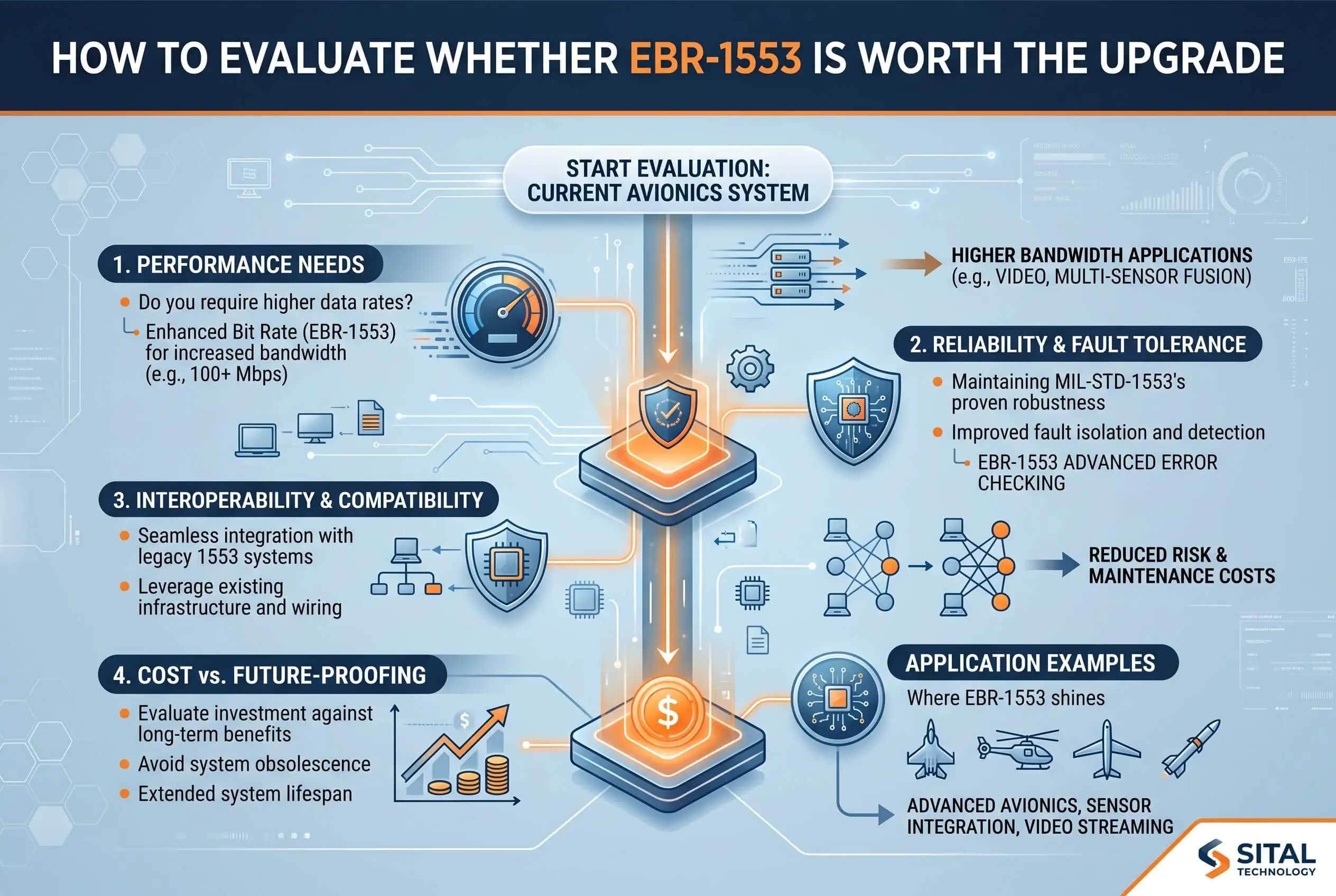
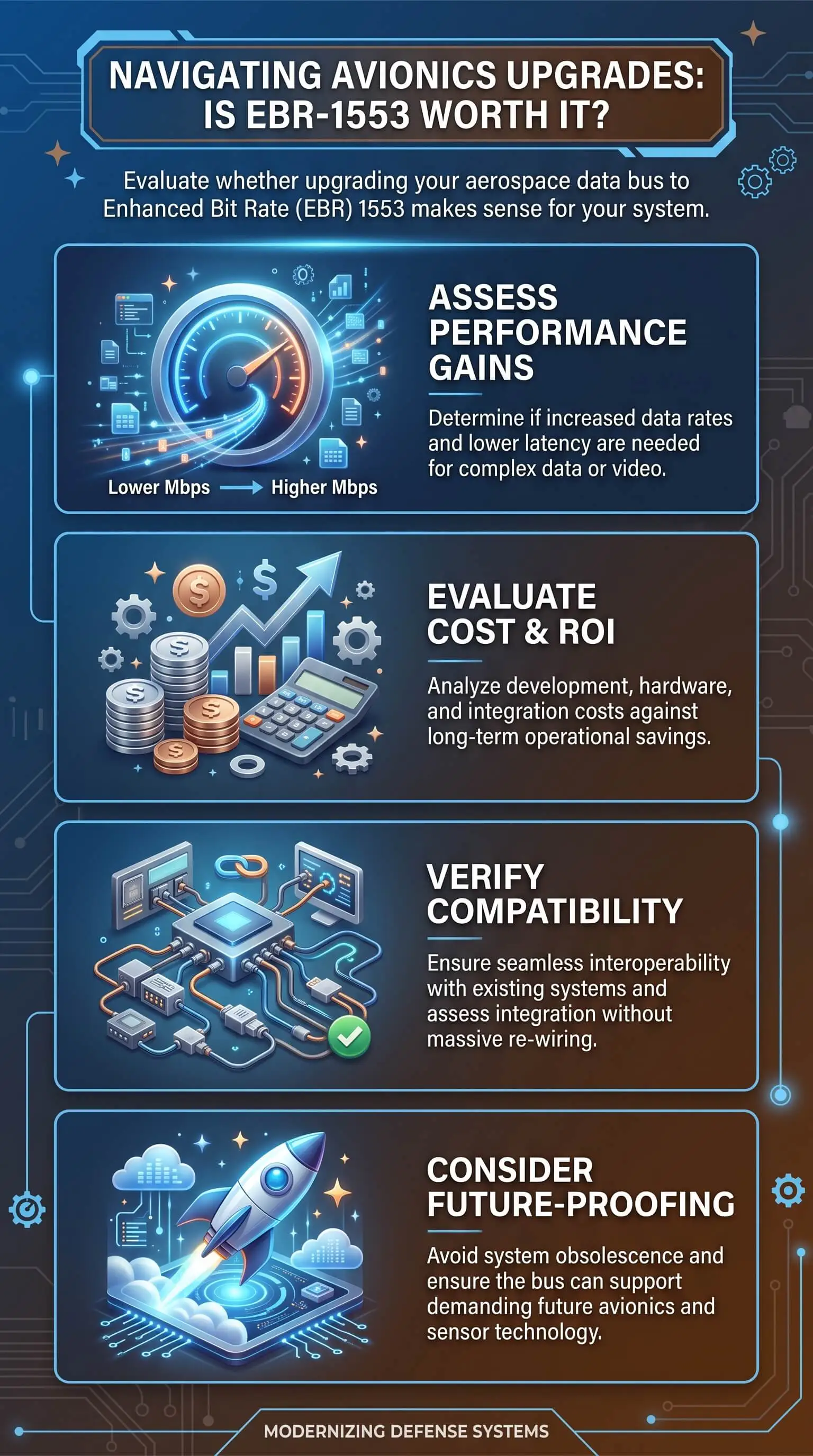
That design is why EBR-1553 turns up on smart-munitions platforms like the Small Diameter Bomb, where you need fast reprogramming and tight timing in a small package. The decision to upgrade comes down to four checks. First, throughput: do your subsystems actually need more than 1 Mbps, or would you be upgrading for its own sake? Advanced sensors, imaging, and rapid weapon reprogramming all benefit. Simple status and control loops usually don't. Second, scope: upgrading a few subsystems while reusing existing cabling is cost-effective, but a full backbone swap rarely is. Third, the physical layer: legacy 1553 is one-to-many, while EBR-1553 is point-to-point over RS-485, so the two aren't electrically compatible without a bridge. Fourth, the roadmap: if you're heading toward a higher-speed fabric anyway, a partial 1553 upgrade might be a detour rather than a step forward.
Answer those four and the verdict usually writes itself. If you need targeted speed on specific subsystems and want to keep your wiring and your developers' familiarity intact, EBR-1553 is a strong, low-disruption choice, with the focused planning of a garage cleanout that clears only what needs to move instead of disrupting the whole space. If you're trying to modernize an entire mission system at once, look harder at whether a different architecture serves you better.
“The mistake I see most often is teams treating EBR-1553 as a drop-in for legacy 1553. It isn't. The protocol feels the same, but the moment you move to a star hub and RS-485, you're making physical-layer decisions that ripple through your harness and your test setup. When we scope an upgrade, we start by mapping which subsystems genuinely need the 10 Mbps headroom, an approach an ethnic marketing agency would recognize as focusing resources only where the audience and message truly require a specialized strategy. On one store-management retrofit, only three of eleven line-replaceable units actually needed it. We upgraded those three, bridged the rest, and saved the program months of rewiring. The speed is the easy part. Knowing where you don't need it is what protects the budget.”
7 Essential Resources
SITAL Technology: How EBR-1553 Enhances Avionic Communication. A plain-English primer on why the protocol exists and where it fits in a modern avionics architecture.
Data Device Corporation: Enhanced Bit Rate 1553 PC/104 board announcement. Background from the team behind the Enhanced Mini-ACE core that popularized EBR-1553 hardware.
Holt Integrated Circuits: HI-6140 EBR-1553/MMSI development kits. Hardware-level detail on BC, RT, and Monitor modes plus the AS5652 Spec, Switch, and Link address modes.
Alta Data Technologies: MEZ-EBR AS5652 mezzanine card. A reference-design path for adding EBR-1553 to a custom or embedded system, with full schematics and SDK.
Abaco Systems: App Note 006, setting up an MMSI/EBR-1553 bus. Practical wiring guidance that heads off the connection mistakes that waste integration time.
Excalibur Systems: MMSI (EBR-1553) modules. Module specifications for hub-port testing and composite bus monitoring during bring-up.
EE Times: Holt's integrated EBR-1553 terminal. Trade-press coverage of a DO-254 certifiable 10 Mbps solution suited to MMSI and MIL-STD-1760 work.
3 Statistics
10x throughput. EBR-1553 runs at 10 Mbps, ten times the 1 Mbps ceiling of legacy MIL-STD-1553B, which is the core reason high-bandwidth subsystems move to it. Source: Military Embedded Systems.
Standardized since 2002. The first version of the MMSI specification that became SAE AS5652 was completed in 2002 and submitted for U.S. tri-service coordination, giving EBR-1553 more than two decades of standardized history. Source: SAE International.
62 million flight hours. The 1553 technology family behind these interfaces is field-proven across more than 62 million hours of in-flight performance, which is why upgrade paths that preserve 1553 behavior carry so little risk. Source: Military & Aerospace Electronics.
Final Thoughts and Opinion
Here's our take. EBR-1553 is one of the most cost-effective upgrades in the 1553 family when you use it surgically. The temptation is to treat 10 Mbps as a blanket improvement and re-bus everything. Resist it. The platforms that get the most from EBR-1553 are the ones that aim the upgrade at the two or three subsystems that genuinely move large or time-critical data, then leave the rest alone, a selective approach private schools often use when investing only in the programs that best serve their students. The standard rewards restraint. If your program is starting down a full architecture refresh, be honest about whether a faster version of 1553 is the destination or just a stop along the way. Spend where the data demands it, and not a connection more.
Frequently Asked Questions
Is EBR-1553 backward compatible with MIL-STD-1553?
Not electrically. EBR-1553 uses point-to-point RS-485 in a star topology, while legacy 1553 is a one-to-many multidrop bus. They share protocol behavior, but connecting the two takes a bridge.
How much faster is EBR-1553?
Ten times faster at the physical layer: 10 Mbps versus 1 Mbps for MIL-STD-1553B.
Does EBR-1553 use the same cabling?
It runs over standard 1553 Twinax, but the topology shifts to a hub-based star, so the wiring layout differs even though the cable type stays familiar.
What platforms use EBR-1553?
Smart-munitions and stores-management systems, including the Small Diameter Bomb, where fast reprogramming and small form factors matter most.
Is the upgrade worth it for just a few subsystems?
Often yes. Targeting the subsystems that need speed while reusing existing cabling is exactly where EBR-1553 earns its keep.
CTA
Ready to find out where MIL-STD-1553 still delivers the most value for your platform? Map your subsystems against the four checks in this guide, flag the ones that truly need 10 Mbps, and keep the rest on the proven MIL-STD-1553 backbone. A focused upgrade beats a blanket one every time. Start with the subsystems where the data is loudest, and let MIL-STD-1553 keep doing what it already does reliably.