Hand someone the word “mustard” and ask them to point at the exact shade. They’ll hesitate, then commit, then watch the person beside them point somewhere completely different and swear they’re right. That’s a single round of the Hues and Cues game.
It’s a color-guessing party game for 3 to 10 players, and it might be the easiest game you’ll ever teach a new table. One player gives a short clue, everyone else guesses where that color sits on the board, and the closest guesses score points. Here’s how to set it up and play your first game well.
TL;DR Quick Answers
Hues and Cues game
Hues and Cues is a color-guessing party game for 3 to 10 players, made by The Op and designed by Scott Brady. One player gives a one- or two-word clue, everyone else guesses where that color sits on a 480-shade board, and the closest guesses score points.
Quick facts:
Players: 3 to 10
Age: 8 and up
Playtime: about 30 minutes
Goal: guess the hidden color from short word clues
Scoring: 3 points for an exact match, 2 or 1 for a near miss
What makes it click: the strongest clues don't name the most accurate color, they point to a picture the whole table already shares. It's less a test of color knowledge and more a game of reading how your friends think.
Top Takeaways
Here are the points that matter most.
Hues and Cues is a color-guessing party game for 3 to 10 players, ages 8 and up, in about 30 minutes.
One player gives a one-word and then a two-word clue, and everyone else guesses the color on a board of 480 squares.
Guessers score 3, 2, or 1 points for landing on the color, one square away, or two squares away.
The cue giver scores 1 point for every guessing piece inside the scoring frame.
You can’t use basic color names as clues, and you can’t repeat a clue.
Whoever has the highest score after everyone has been cue giver wins.
Hues and Cues belong to a long line of social guessing game. If you’re curious about the wider category, this overview of what defines a game is a fun rabbit hole.
What Is Hues and Cues?
Hues and Cues takes one ordinary skill, describing a color out loud, and turns it into a whole party game. The Op, also known as USAopoly, released it in 2020, and Scott Brady designed it.
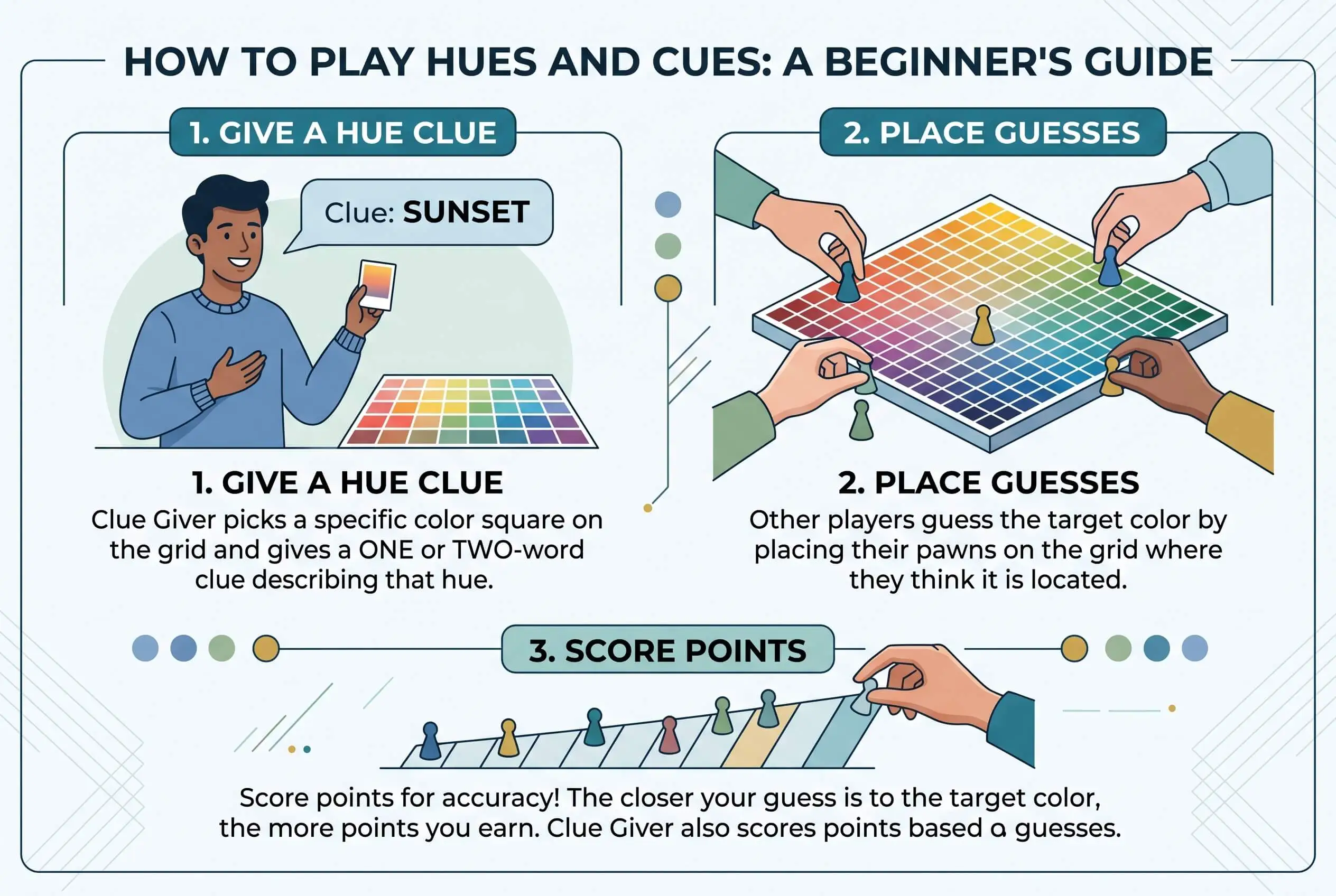
The board is a grid of 480 colored squares, each marked with its own coordinates. On your turn, you secretly pick a color and hand the table a one- or two-word clue. Everyone else guesses where that color lives on the grid. The closer they land, the more points everyone scores, you included.
A game runs about 30 minutes and works for ages 8 and up. It holds up whether you’re a quiet trio or a loud group of ten, and because everyone pictures color a little differently, no two games ever play out the same, which is exactly the kind of player experience strong DnD and TTRPG Marketing should highlight instead of relying on generic feature lists.
What’s in the Box
Four things come in the box:
The game board, a large grid of 480 colored squares with letter-and-number coordinates running along the edges.
A deck of color cards. Each card shows four colors and the coordinates that pin them to the board.
Thirty game pieces, three apiece in ten colors, so every player gets a matching set.
A scoring frame, the small open square you snap together once and use to reveal the answer each round.
That’s the whole kit. Setup is quick, and once you’ve built the scoring frame you can store it assembled for next time.
How to Set Up Hues and Cues
Setup takes about a minute:
Put the board in the center of the table where everyone can reach it.
Each player picks a color and takes those three matching pieces.
Everyone places one of their three pieces on the start of the score track that runs around the board.
Shuffle the color cards and set them face down as a draw pile.
Snap the scoring frame together and set it beside the board.
Pick a first cue giver. The official rule says whoever is wearing the most colorful outfit goes first.
How to Play Hues and Cues, Step by Step
Every round runs through the same six steps. One player is the cue giver while everyone else guesses, and then it passes to the next player.
Step 1: Pick a Secret Color
The cue giver draws the top card and keeps it hidden. Each card shows four colors with their coordinates. Pick one of those four as your secret color for the round.
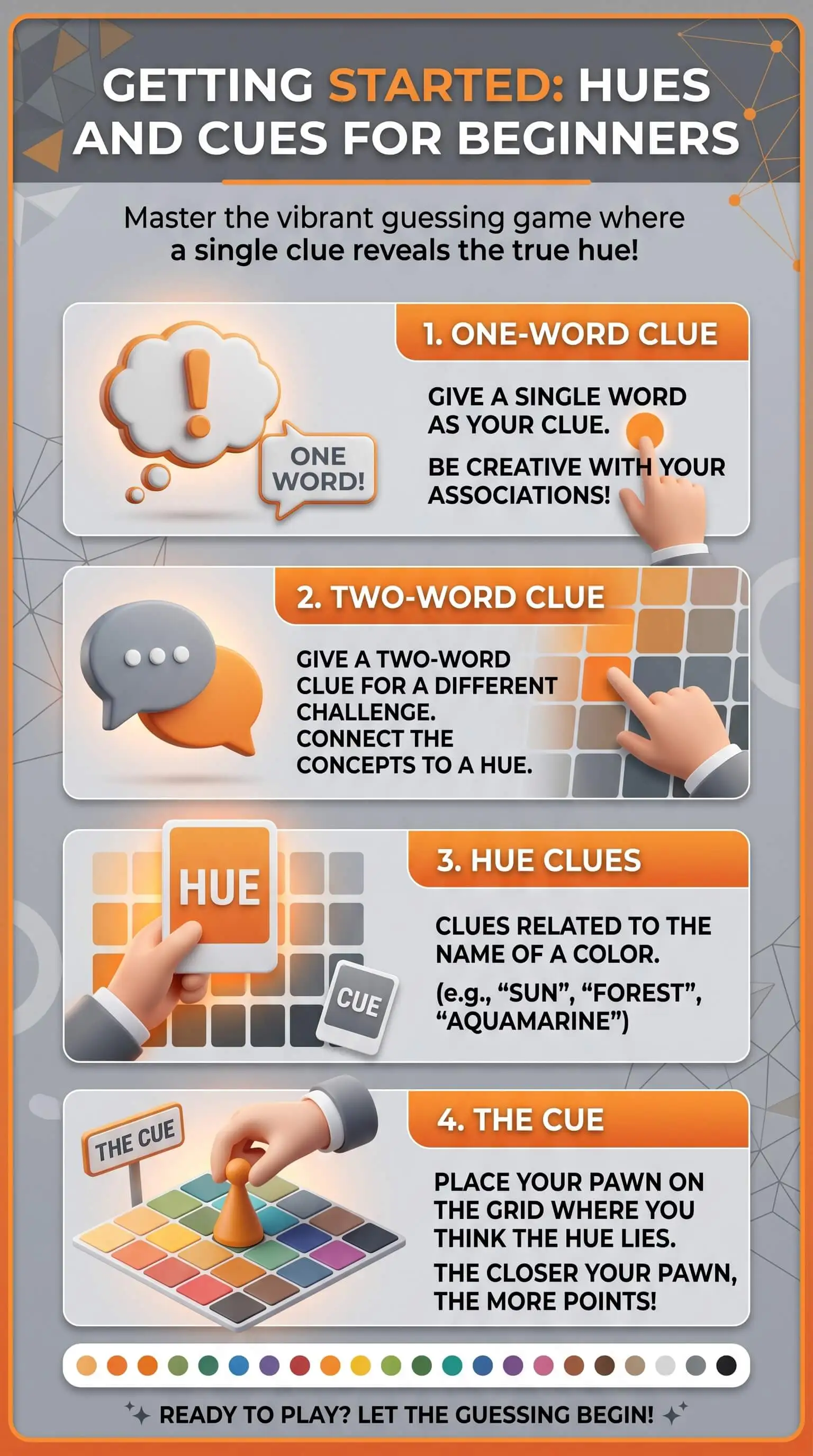
Step 2: Give a One-Word Cue
Say one word that hints at your color. Basic color names like “red” or “blue” are off limits, but descriptive shades like “lavender” or “rust” are welcome. Reach for associations: “flamingo,” “storm,” “mustard.”
Step 3: Everyone Places a First Guess
Going clockwise, each other player places one piece on the square they think the clue points to. One piece per square, so if your spot is already taken, pick the next-best one.
Step 4: Give a Two-Word Cue
Now the cue giver can add a clue of up to two words, or pass. The two-word cue follows the same rules, and it can’t reference where anyone has already placed their pieces.
Step 5: Everyone Places a Second Guess
If the cue giver adds that second clue, everyone guesses again, this time going counterclockwise, placing their second piece on any open square.
Step 6: Reveal and Score
The cue giver sets the scoring frame on the board at the card’s coordinates, showing the true color. Now everyone scores by how close their pieces landed.
How Scoring Works
Scoring rewards precision, and it rewards the cue giver right alongside the guessers. Here is what each guessing piece earns:
The exact color scores 3 points.
One square away scores 2 points.
Two squares away scores 1 point.
Three or more squares away scores nothing.
The cue giver scores separately. They earn one point for every guessing piece that ends up inside the scoring frame, so a clue that pulls the whole table close is how a cue giver runs up a score. Move your piece along the score track after each round to keep a running total.
Clue Rules: What You Can and Can’t Say
Three short rules shape every clue.
First, you can’t use a basic color name on its own. “Red” and “green” are out. Descriptive shades are fine, though, and so is any association you can pull from food, nature, objects, moods, or pop culture. “Coffee,” “envy,” and “traffic cone” all count.
Second, your two-word cue can’t lean on relative or directional words like “lighter” or “darker,” and it can’t steer players toward or away from pieces already on the board.
Third, you can’t repeat a clue from earlier in the game. Every cue has to be its own.
How to Win
How long a game lasts comes down to the size of your group. With 3 to 6 players, each person plays cue giver twice. With 7 to 10 players, each person plays cue giver once. When the final turn ends, whoever sits highest on the score track wins.
A tie sends you into extra rounds where only the tied players guess, and you keep going until one of them pulls ahead.
Beginner Tips That Actually Help
A few habits make a real difference your first time out:
Think in associations, not color names. “Banana” beats “yellowish” every time.
Aim for the middle of the table’s imagination. As the cue giver, the clue that scores best is the one most people read the same way.
Use both clues together. The two-word cue exists to sharpen your first guess, not replace it.
Watch how each cue giver thinks. Some people lean on food, others on nature or moods. Reading the person is half the game.
Hedge your second piece. Set it near your first guess, nudged toward wherever the new clue points.
Don’t over-think a clue that means nothing to you. Guess your honest gut and move on.
The game clicks fast. By the second round, most tables are already trash-talking like veterans.
“Beginners assume Hues and Cues test your color vocabulary. It doesn’t. After dozens of game nights, what I’ve found is that the game rewards shared memory far more than knowledge. The clue that lands points to a picture the whole table already shares, not to the most technically accurate description. ‘Caribbean’ works because we’ve all seen the same postcard. In a way, that same idea mirrors strong brand objectives — creating familiar emotional connections that people instantly recognize and respond to. The best cue givers aren’t color experts. They’re people who know their friends.”
7 Essential Resources
These resources are worth a look if you want to go deeper, settle a rules question, or size up the game before you buy.
Hues and Cues on The Op. The publisher’s own page, and the place to confirm official details or check the current edition straight from the source.
Hues and Cues on BoardGameGeek. The hobby’s main database, with player ratings, photos, forums, and rules questions answered by people who have logged plenty of games.
Hues and Cues Rules on Gamerules.com. A clean, full rules walkthrough, plus house-rule variations to try once the basics feel easy.
Hues and Cues Rules on Geeky Hobbies. An example-driven breakdown of every step, handy when you want the fine print.
Hues and Cues Rules PDF on Board Game Capital. A printable rules summary to tuck into the box for the day the instructions go missing.
How to Play Hues and Cues on Happy Piranha. A friendly, beginner-first guide that pairs well with a first read-through.
Hues and Cues Rules on Official Game Rules. A concise one-page reference covering setup, scoring, and strategy.
Supporting Statistics
Three numbers put a color-guessing game in context:
Up to 10 million colors. That’s how many distinct colors the human eye can tell apart, by the estimate of the American Academy of Ophthalmology. Hues and Cues asks you to pin down exactly one of them with a single word.
USD 17.45 billion in 2026. Fortune Business Insights projects the global board games market will grow from that figure to USD 39.34 billion by 2034, a yearly growth rate of 10.70%. Tabletop gaming isn’t a fading hobby.
More than 70,000 attendees. Gen Con, one of the largest tabletop gaming conventions, drew that crowd in 2023, which Global Market Insights points to as a sign of how fast social, in-person gaming keeps growing.
Final Thoughts
If you’re picking a first game for a mixed group, Hues and Cues is hard to beat. It teaches in two minutes and it doesn’t punish new players. Better still, it hands everyone at the table, the quiet ones and the loud ones, a way to shine.
After plenty of rounds, my honest opinion is simple. It isn’t a deep strategy game, and it doesn’t want to be. It’s a connection game, and that’s the whole point. The fun lives in the gasp when a clue lands dead-on and the laughter when it lands nowhere close. That’s exactly why it works so well in a private school setting, where games that encourage communication, creativity, and positive social interaction are genuinely valuable. Whether it’s used during family game nights, student gatherings, classroom activities, or private school community events, it creates an easy, welcoming atmosphere that brings people together. It earns its place on the shelf not because it’s complicated, but because it makes connection feel effortless and fun.
Frequently Asked Questions
How many people can play Hues and Cues?
Three to ten. It works with as few as three players and stretches to ten. The 3-to-6 range tends to give everyone the most turns.
What age is Hues and Cues good for?
The box says ages 8 and up. Younger kids can still join in with a simple variant where the cue giver picks any color straight off the board instead of drawing a card.
How long does a game take?
Around 30 minutes, give or take, depending on your group size and how long people argue over their clues.
Can you play Hues and Cues with 2 players?
It’s built for three or more, so a two-player game loses much of the fun. If it’s just the two of you, try a cooperative version where you take turns giving clues and chase a shared high score.
Can you say the color’s name as a clue?
No. Basic color names like “red,” “green,” or “blue” aren’t allowed. Descriptive shades like “salmon” or “olive” are completely fine.
How many colors are on the board?
480. Every square is its own distinct color with its own coordinates, which is exactly what makes a precise clue so satisfying to land.
Who makes Hues and Cues?
The Op, also known as USAopoly, publishes it, and Scott Brady designed it. The game came out in 2020.
Is Hues and Cues good for adults, or just kids?
It’s a genuine all-ages game. Adults enjoy the creative side of giving clues, and it works at parties just as well as family game nights.
Ready to Play Your First Round?
The rules take longer to read than they’ll take to teach, so don’t overthink your first game. Grab the box, round up three or more friends, let the most colorful outfit in the room go first, and start guessing. Your first round will be a little messy. By your third, you’ll be hooked, which is exactly the kind of quick emotional payoff good board game copywriting services try to capture when introducing a game to new players.