Ask an agency owner what a project actually earned after the freelancers got paid, and you'll often hear a long pause. The books usually explain why. A dozen contractors spread across six retainers can all end up on one P&L line labeled "contract labor."
The answer usually starts with a better accountant. For an agency that runs on freelancers, that means someone who collects contractor paperwork before the first payment goes out, ties each freelancer invoice to the client it belongs to, and spots classification risk while it's still cheap to fix. Filing a return every spring is the easy part. Most owners figure that out about the time they start looking for accountants for creative agencies instead of a generalist.
An accountant who knows agency work gives you clear visibility into what each project earns once the freelancers are paid. Here's how to find one.
TL;DR Quick Answers
Accountants for Creative Agencies
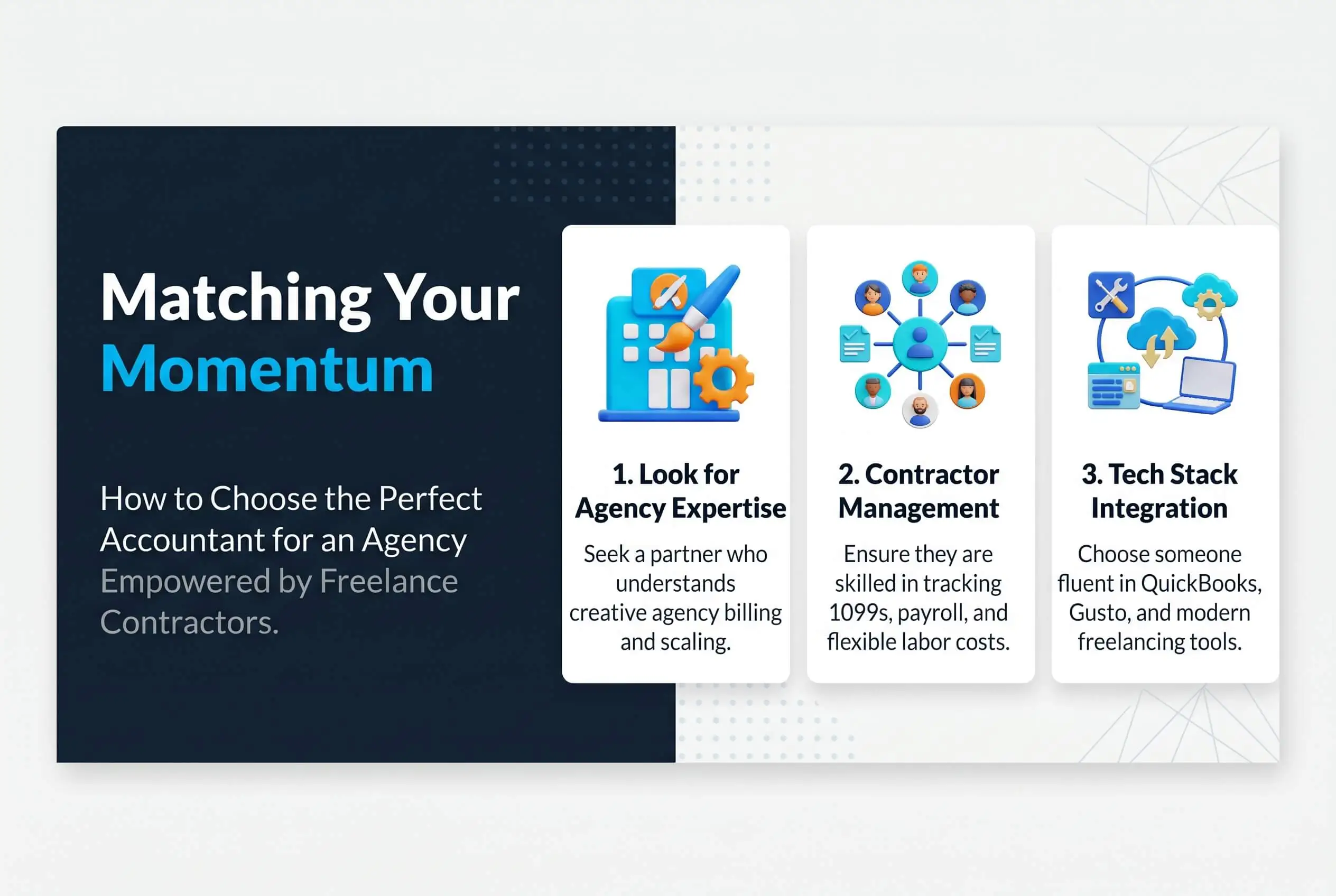
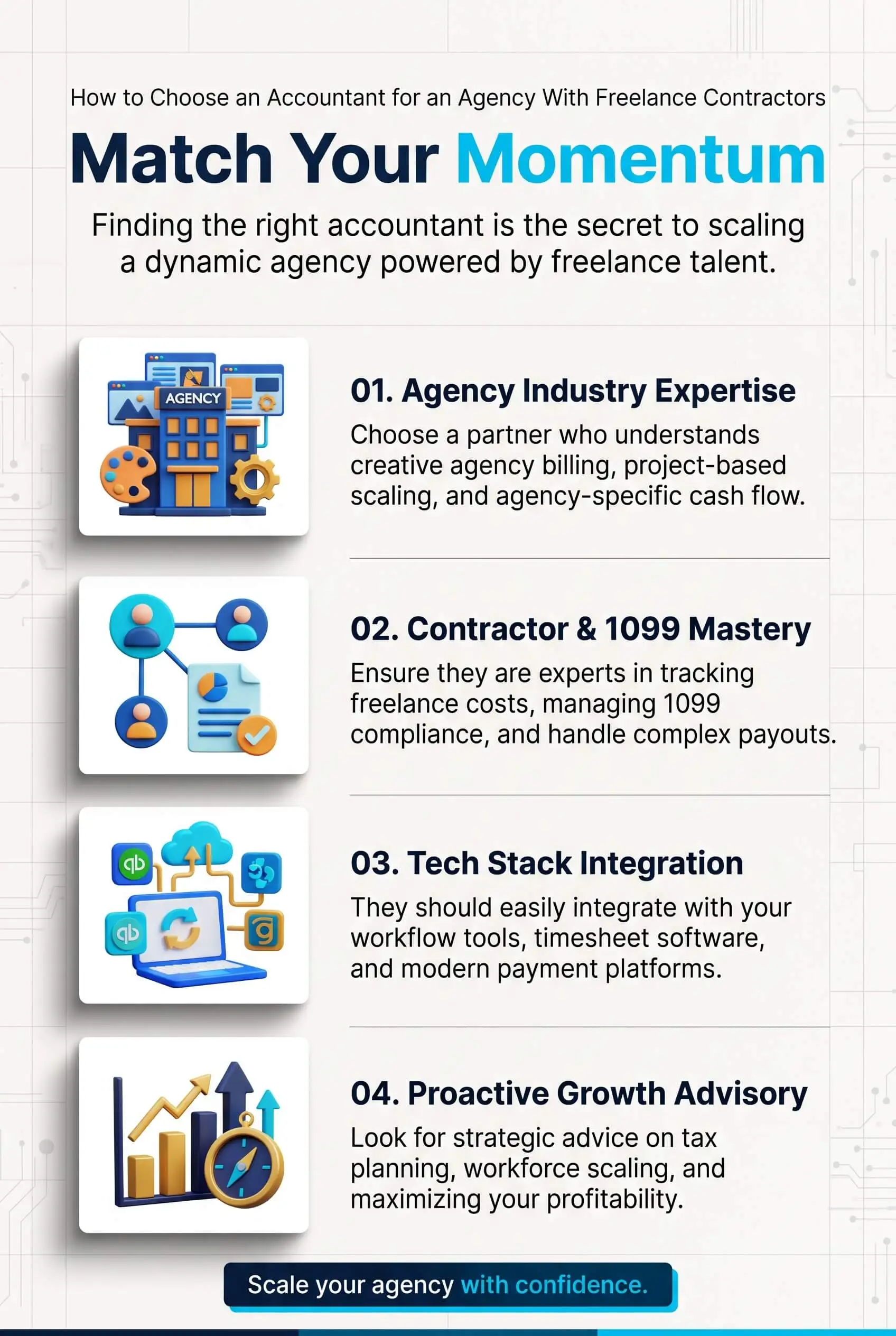
Accountants for creative agencies track profit by client and project, not just by month, so owners can see which retainers and campaigns actually make money once freelancers are paid. Look for a firm that handles:
Project and retainer profitability: time and contractor costs measured against each budget, so scope creep shows up before it erodes margins.
Contractor workflows: W-9s at onboarding, freelancer payments, and 1099-NEC filing (a $2,000 threshold for payments made in 2026).
Pass-through costs: reimbursable expenses billed back to clients on time to protect cash flow.
Cash flow forecasting: incoming work mapped against payroll and freelancer payments.
Agency tools: QuickBooks connected to time tracking, payroll, and payment platforms like Harvest, Gusto, and BILL.
The short version: a good agency accountant gives you visibility into margins, not just clean books at tax time.
Top Takeaways
Hire an accountant who builds 1099 prep and job costing into the monthly close so January stays calm.
For payments made in 2026, the Form 1099-NEC reporting threshold is $2,000 per contractor. Freelancers still owe tax on smaller amounts.
Classification depends on how the relationship actually works, and California's AB 5 starts from a stricter default than federal rules.
Track contractor costs by client and project so you can see true profitability.
Match the role to your stage, whether that's a bookkeeper, a CPA, an outsourced firm, or a fractional CFO.
Why Freelancer-Heavy Agencies Need Specialized Accounting
Freelancers change the shape of an agency's costs. At some shops, contractor spend comes close to payroll, and a good chunk of it gets billed back to clients as pass-through cost.
Timing is where it gets uncomfortable. Freelancers want to be paid when they deliver, but clients pay on retainer cycles and milestones, so your cash covers the gap. If you've read up on how advertising companies make money, you know that gap is where margins are won or lost.
A generalist sees one expense line. You need that line broken out by client and retainer, because that's the only way to tell which work pays and which work is quietly eroding your margin.
What Accountants for Creative Agencies Should Handle for Your Contractors
They should own the contractor side of your books from the first W-9 through the last 1099, along with the project reporting that shows whether freelancers are helping your margins. In practice, that covers five jobs.
Onboarding. Collect a Form W-9 before the first payment, so the correct taxpayer ID is on file long before filing season.
1099-NEC reporting under the 2026 rules. For payments made in 2026, the Form 1099-NEC reporting threshold rises from $600 to $2,000, with inflation adjustments starting in 2027. Your filing requirement changes. Your freelancers' tax bill on smaller payments doesn't.
Payment platform mapping. Card processors and payment apps may report some freelancer payments on Form 1099-K instead, so your accountant needs to know how you pay each contractor.
Job costing. Your accountant tags every contractor invoice to the client or retainer it belongs to.
Pass-through costs. Your accountant bills reimbursable expenses back to clients promptly, so your working capital isn't financing their projects.
We see the difference most clearly in January. Experienced accountants for creative agencies build contractor payments and 1099 workflows into the monthly close, so year-end is a review instead of a scavenger hunt for missing forms. That habit also heads off the common bookkeeping mistakes that tend to snowball by tax time.
Worker Classification: The Risk Agency Owners Underestimate
Calling someone a freelancer doesn't make them one. Regulators look at how the relationship works day to day, whatever the contract says.
The IRS weighs behavioral control, financial control, and the type of relationship, and no single factor settles the question.
California sets a higher bar. Under AB 5, which took effect January 1, 2020, the state presumes a worker is an employee unless the business meets the ABC test. Certain marketing and graphic design work, plus qualifying business-to-business arrangements, falls under the older Borello test instead, but only when specific conditions are met.
Here's a pattern we'd flag for any Los Angeles agency: a "contract" copywriter who writes the exact deliverables you sell, works only for you, and can't turn down assignments. A good accountant notices that and loops in an employment attorney rather than making the legal call alone.
Seven Questions to Ask Before Hiring an Agency Accountant
Bring these to your first call. How a firm answers tells you fast whether it understands agency work.
How many agency or creative clients do you work with today?
How do you handle W-9 collection and year-end 1099 filing?
Can you report profitability by client, project, and retainer?
Which tools do you work in? (Listen for QuickBooks, Harvest, Gusto, BILL, or Ramp.)
How do you track pass-through costs and client rebilling?
Will you flag contractor classification risks, and who do you refer out to?
What does monthly reporting look like, and how many days does your close take?
If you're in California, check any CPA's status on the California Board of Accountancy license lookup before you sign.
Bookkeeper, CPA, Outsourced Firm, or Fractional CFO?
Which one you need depends on your size and how tangled your contractor mix has become.
Bookkeeper: Records payments, collects W-9s, and keeps the books current. A good fit for early agencies working with a few freelancers.
CPA: Handles tax filings, reviews 1099 compliance, and plans ahead on taxes. Every agency needs one at tax time, often alongside a bookkeeper.
Outsourced accounting firm: Runs the full monthly close, job costing, contractor workflows, 1099s, and reporting. Built for growing agencies that use freelancers every month.
Fractional CFO: Leads cash flow forecasting, margin strategy, and the hire-or-contract decision. Worth it once you're planning growth and weighing staff against freelancers.
Red Flags When Evaluating an Accountant
All contractor spend goes into one overhead line.
You only hear from them at tax time.
They can't explain what the 2026 1099 changes mean for you.
Retainers and job costing are unfamiliar territory, or they offer to settle classification questions without legal counsel.
"When we take over the books for a creative firm, the freelancer line is almost always where the surprises are. Contractor costs end up in overhead instead of on the projects that created them, and a retainer that looks healthy turns out to be losing money every month. Once each freelancer invoice is tied to a client, owners stop guessing. They can see which accounts carry their margins, and the decision about when to hire instead of contract gets a lot easier."
7 Essential Resources
IRS: Independent Contractor (Self-Employed) or Employee? The IRS's own breakdown of the factors it uses to classify workers, along with relief options if you've classified someone wrong.
IRS: About Form 1099-NEC, Nonemployee Compensation Where to get the current form and instructions.
IRS: About Form W-9 The form every freelancer should fill out before you pay them a dollar.
California Labor and Workforce Development Agency: Independent Contractor vs. Employee California's AB 5 portal, with separate pages for employers and a plain explanation of the ABC test.
Patriot Software: 1099 Reporting Threshold Increases to $2,000 A short, readable summary of what changed for 2026 payments.
Xero: 1099-NEC and 1099-MISC Filing Requirements 2026 Useful for deadlines and for understanding how the 1099-K threshold fits in.
California Board of Accountancy: Verify a License Look up any California CPA or accounting firm's license status and disciplinary history.
3 Statistics
$600 to $2,000. For payments made in 2026, the Form 1099-NEC reporting threshold more than triples. It's the first change to that threshold since 1954. (TaxBandits)
40 percent more freelancers. Across 150+ advertising agencies, the number of freelancers engaged in Q1 2024 was 40 percent higher than in Q1 2023. (Worksome)
81 percent versus 38 percent. In a Harvard Business Review Analytic Services survey, 81 percent of respondents called freelancers important to their organization, while only 38 percent said they manage them very effectively. (Fiverr press release)
With the 1099-NEC reporting threshold rising from $600 to $2,000 for 2026 payments, freelance hiring increasing by 40% among surveyed advertising agencies, and only 38% of surveyed organizations managing freelancers very effectively, contractor management is becoming increasingly important. These findings also offer useful lessons for private schools that hire freelance educators, tutors, and creative professionals, highlighting the value of organized payment tracking, accurate financial records, and effective contractor management.
Final Thoughts and Opinion
Our view is simple: the best accountant for a freelancer-heavy agency pays for themselves by finding margin. Filing forms is table stakes. The 2026 1099 changes will tempt some owners to relax their paperwork, and that's a mistake, but compliance alone won't tell you which clients are worth keeping.
The agencies we've seen struggle aren't the ones with the most freelancers. They're the ones who can't see where those freelancers show up on the P&L. Once that picture is clear, pricing and hiring stop feeling like guesswork.
Give a new accountant a few months. If you still can't see contractor costs by project after that, keep looking.
Frequently Asked Questions
What should a creative agency look for in an accountant?
Start with experience. Good accountants for creative agencies already work with agency clients, have a set process for W-9s and 1099s, and can report profitability client by client. Ask which tools they use and how they rebill pass-through costs. Vague answers on contractor workflows are a warning sign.
Do agencies have to send 1099s to freelancers in 2026?
In most cases, yes. For payments made in 2026, you file Form 1099-NEC once a contractor's payments hit the new $2,000 threshold, up from $600. The threshold adjusts for inflation starting in 2027. If you pay freelancers through card processors or payment apps, those platforms may report the payments on Form 1099-K instead.
Can an accountant tell me whether a freelancer should be an employee?
They can spot the warning signs and walk you through the IRS factors and California's ABC test. The final call carries legal risk, though. When a working relationship starts to look more like a job than a contract, a good accountant brings in an employment attorney.
Is a bookkeeper enough for an agency that uses contractors?
Early on, often yes. A young agency with a few freelancers can get by with a bookkeeper and a CPA at tax time. Once contractor spend grows or spreads across many clients, outsourced accounting adds the job costing, reporting, and dependable monthly close you'll need.
How much do accountants for creative agencies cost?
It depends on your transaction volume, how many contractors and clients you have, how many systems need to talk to each other, and whether you want strategic support like a fractional CFO. Most firms scope a monthly fee after looking at your books, so ask for a proposal built around your setup.
Get Clarity on Your Agency's Contractor Costs
If your freelancer costs are harder to track than they should be, a short conversation is a good place to start. Accountix helps creative firms bring structure to contractor payments and project profitability through professional accounting services. Book a 30-minute intro call and we'll talk through your setup. No sales pitch, just clarity on where your margins stand.